FTMO trading journal: track your prop firm rules trade by trade
The FTMO rules to carry into your journal, the routine that protects a challenge, and what 111,000 trades show: daily loss, risk and mistakes.
 By Ricardo · Founder of ProTradingLabs7 min read
During an FTMO challenge, one trade too many is enough to lose the account: a daily loss limit broken after a revenge streak, an oversized lot taken "to win it back". A trading journal is then less about improving than about staying in control: knowing, before each session, where you stand against the rules.
The FTMO rules to follow in your journal
FTMO offers two challenge formats. Here are their objectives, as published on the official trading objectives page on November 1, 2026:
| Rule | 2-Step Challenge | 1-Step Challenge |
|---|---|---|
| Profit target | 10% (phase 1), then 5% (verification) | 10% |
| Maximum daily loss | 5% | 3% |
| Maximum loss | 10%, static | 10%, trailing the highest end-of-day balance |
| Minimum trading days | 4 | None |
| Consistency | Your best day must not exceed 50% of the profit | Same |
Two details matter for your journal:
- The daily loss is computed from the balance recorded at midnight, Prague time (CET or CEST), and it includes the losses of positions still open.
- The maximum loss is measured on equity, so open positions count too.
Rules change: always check those of your account in your FTMO client area.
To understand FTMO in detail (phases, rules, payouts), Benjamin Deleuze, trader, mentor and partner of ProTradingLabs, dedicates a full course to it:
Carry these rules into your trading plan
Each journal's trading plan holds the rules of your challenge. You set:
- your daily, weekly and monthly loss limits, in the account currency;
- your maximum risk per position;
- allowed or banned symbols;
- your trading hours and days, and months without trading;
- the economic news windows to avoid.
With ProTradingData, a few settings are enough to make the journal match FTMO:
The right time zone. Set the time zone to Europe/Prague: the journal's day then starts at the same moment as FTMO's.
A lower daily limit. The journal counts closed positions; FTMO also counts those still open. On a €100,000 2-Step account, a limit of €4,000 rather than €5,000 leaves you a margin.
A risk per position that survives the day. At 1% per trade, four losses in a row stay under the 5% limit. At 2%, three losses break it.
News. If your account bans some news releases, tick their impact levels and the window before and after.
A rule left empty checks nothing: you only set what matters for your prop firm. The plan saves as you type (how to set it up). The 10% maximum loss has no direct equivalent in the plan: follow it on the dashboard's capital curve.
Every trade checked against the plan
With ProTradingData, each position is checked against the plan as soon as it reaches the journal, with nothing to type. Loss limits are checked again at close. You see the share of your trades that follow the plan, and the detail of the rules broken.
In this example, 92% of positions follow the plan, and the rule broken most often is trading outside the planned hours.
A position outside the plan carries a red badge in the trade list. Its detail compares, rule by rule, what was expected with what happened: that is where you see the daily loss was already almost reached when you reopened a position.
Where do you stand on your limits?
The journal dashboard shows how much of your daily, weekly and monthly loss limits you have used. Before opening a new session, you know how much room you have left.
Here, the day has used €180 of €500, and the week €420 of €1,200: there is room for two normal losses, not for a streak.
What 111,000 synced trades show
We studied 111,437 positions from 504 MetaTrader and cTrader traders. Three figures apply directly to a challenge:
- 35% of positions are opened without a stop loss. Without an initial stop, neither you nor the journal know the real risk of the trade.
- 11.5% of losses exceed the planned risk by more than 10%. On a day already under pressure, that overshoot is what breaks the daily loss.
- Trading again within 30 minutes of a loss does worse than waiting two hours for 62% of traders. It is the rush, more than revenge, that costs (revenge trading in numbers).
The method and all results are in our study: trading statistics on 111,000 trades.
Is FTMO's free journal enough?
FTMO provides a journal in its client area. According to FTMO, you document each trade once closed, with screenshots, free text on the entry and exit, and tags to filter.
For a single FTMO account and simple notes, that can be enough. A separate journal becomes useful when:
- you trade several prop firms, or a personal account besides FTMO, and want to see everything in one place;
- you want every trade checked automatically against your rules, instead of checking it yourself;
- you want to measure your mistakes and trading hours, not just write them down;
- you keep your history from one challenge to the next, even once the account is closed.
Understand what makes you fail a challenge
Failed challenges often look alike: FOMO, a moved stop, an early exit, a revenge trade. You tag your mistakes on your positions, and ProTradingData sorts them by category, by trade phase and over time.
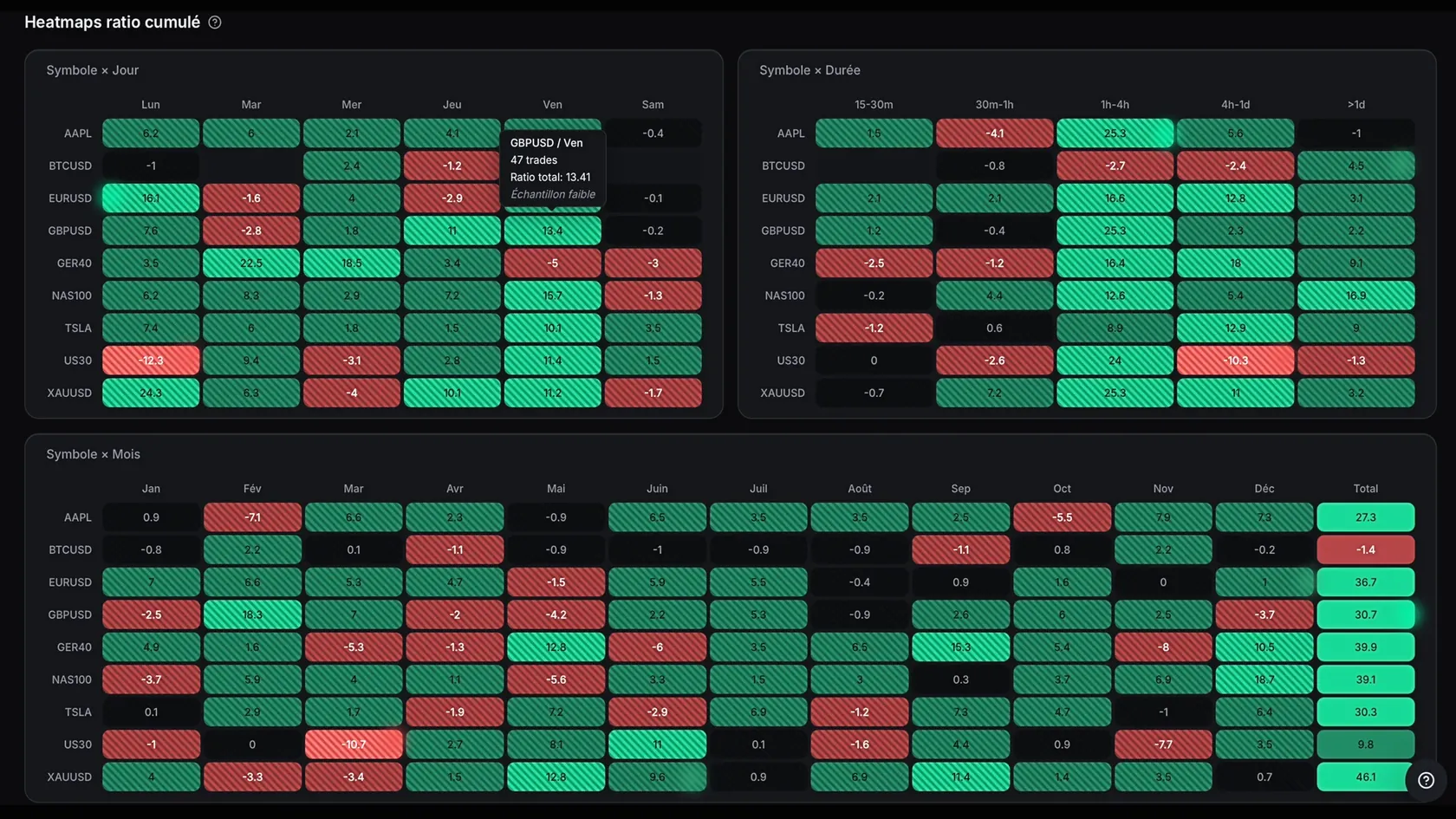
Heatmaps cross your results by symbol, day and hour: you see whether your losses cluster on Monday mornings or on one instrument.
A journal routine for the whole challenge
Before the session. Look at the daily and weekly loss gauges. If the room left does not cover two full losses, lower your risk or do not trade.
After each trade. Add a short note and, where relevant, the mistake made. If the trade lost, reread your plan before opening another one.
At the end of the week. Review plan compliance, mistakes and heatmaps. Write down one thing to change the next week.
Between phases. Compare phase 1 and the verification on the same statistics: the verification should look like phase 1, not chase it.
The catch-up trade, from the inside
In April 2026, Benjamin Deleuze interviewed an FTMO trader at maximum allocation, with €400,000 of capital. He tells how a loss pushed him to risk more than planned:
At times, I risked a bit more than I should have, to try to win that loss back.
That trade is not the rule: in our data, the trade after a loss does no worse on average than the trade after a win. But for the traders it affects, it costs a lot, and the journal's trading plan flags it as soon as it exceeds the maximum risk per position.
Several challenges, one place
One journal per challenge or funded account, each with its own plan. A journal can also group several accounts, to follow all your trading, FTMO and other prop firms included.
Frequently asked questions
Does ProTradingData work with FTMO?
Yes, with any FTMO account on MetaTrader 5, MetaTrader 4 or cTrader: your trades reach your journal automatically.
Does ProTradingData stop me from breaking the daily loss limit?
No. The journal neither places nor blocks orders: it records your trades, compares them with your plan and flags every position that breaks it.
Does ProTradingData compute the daily loss the way FTMO does?
Not exactly. ProTradingData counts closed positions, in the time zone of your settings. FTMO also counts open losses, from the balance at midnight Prague time. Set the Prague time zone and a lower limit than FTMO's.
Isn't FTMO's free journal enough?
For a single FTMO account and simple notes, it can be. A separate journal adds automatic sync, several prop firms in one place, rule checks on every trade and mistake analysis.
Can I track several challenges at once?
Yes. Each account has its own journal and its own trading plan, and a journal can also group several accounts.
How much does ProTradingData cost?
€14.99 per month with a 14-day free trial, or €199.99 once for lifetime access.
Keep reading
ProTradingLabs is not affiliated with FTMO, MetaQuotes, Spotware or TradingView. Trading leveraged products carries a risk of capital loss.