Stop loss and risk management: how much to risk per trade
Where to place the stop, how to size a position, how much to risk per trade and why: losing streaks in numbers, and what 111,000 trades show.
 By Ricardo · Founder of ProTradingLabs6 min read
Most accounts do not die from a bad strategy, but from badly sized risk: a trade without a stop, an oversized position after a loss, a stop moved away "to give it room". Risk management is the least exciting part of trading, and the one that decides whether you will still be here in six months.
A stop loss from the moment you open
A stop loss is not optional. It sets what you accept to lose if the idea is wrong, and it gives the trade its unit of measure: R, the risk taken. A +2 R trade made twice its risk; a −1 R trade lost exactly what was planned.
In our study of 111,000 trades synced from MetaTrader and cTrader, 35% of positions were opened without a stop loss, and 75% of traders did this at least once (see the study). Many place their stop a few seconds after entry. The problem: MetaTrader does not keep that stop on the entry order, and cTrader does not send it. Your journal then knows neither the risk nor the result in R.
Where to place the stop
The stop goes where your scenario no longer holds: below the last low of a rising structure, above a broken resistance, beyond a key level. Not at a number of pips chosen so that the loss "does not hurt too much".
Position size adapts to the stop, never the other way round. A wide stop with a small size and a tight stop with a large size can risk exactly the same amount.
What not to do: move the stop away during the trade. A loss planned at −1 R becomes −1.5 R or −2 R. In our data, 11.5% of losses go below −1.1 R, and 6.2% below −1.5 R. Some of it comes from slippage and gaps; some comes from moved stops.
Calculate position size
The formula fits on one line:
Size = amount at risk ÷ (stop distance × point value)
An example on EURUSD, with a $10,000 account:
Amount at risk. 1% of $10,000 = $100.
Stop distance. The scenario is invalidated 20 pips below the entry.
Pip value. On EURUSD, a standard lot is worth about $10 per pip: 20 pips cost $200 per lot.
Size. $100 ÷ $200 = 0.5 lot.
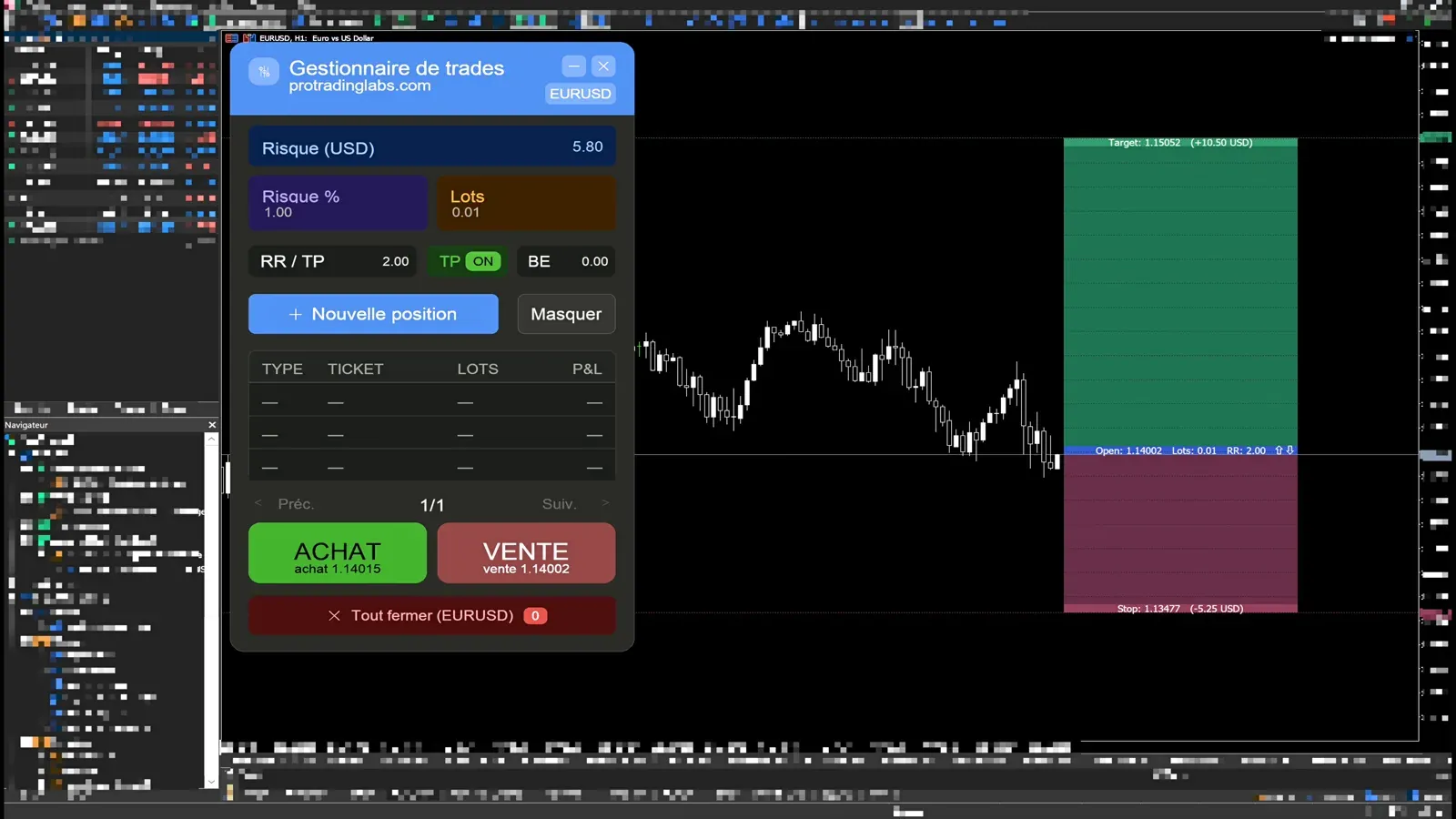
Point value changes from one instrument to another (indices, gold, crypto) and with the account currency. ProTradingData includes a position size calculator, and ProTradingManager, the free trade management EA for MetaTrader 5 included for subscribers, computes the size from your risk percentage and the stop placed on the chart.
How much to risk per trade
The right risk per trade is the one that survives a normal losing streak. And streaks are longer than people think.
With a 38% win rate, that of the average trader in our data, and assuming independent trades, here is the probability of at least one losing streak:
| Losing streak | Over 100 trades | Over 200 trades |
|---|---|---|
| 5 losses | 98.6% | 100% |
| 8 losses | 56.6% | 82.1% |
| 10 losses | 26.0% | 46.6% |
| 12 losses | 10.5% | 20.8% |
A streak of 8 losses is nothing exceptional. Here is what it costs depending on risk per trade:
| Risk per trade (of starting capital) | After 8 losses | After 10 losses |
|---|---|---|
| 0.5% | −4% | −5% |
| 1% | −8% | −10% |
| 2% | −16% | −20% |
On an FTMO challenge, the maximum loss is 10%. At 2% per trade, a common streak is enough to lose the account; at 0.5%, there is room left. That is why 0.5% to 1% per trade is often recommended on a prop firm account.
On a small personal account, the rule changes. Benjamin Deleuze, trader, mentor and partner of ProTradingLabs, makes the point in his April 2026 video on small accounts:
1% of €200 is €2, and as you can guess, with that kind of risk you will not get very far.
On a €200 account, the constraint is not a prop firm's maximum loss but the time it would take to grow the capital. The risk can then be higher, as long as it is set in advance, written in the plan and followed on every trade.
Risk is set on the prop firm account's starting capital, the way the firm does it, not on the day's balance. ProTradingData can compute your risk percentage that way, on your net deposits (the FTMO trading journal).
The trade after a loss
Risk management does not stop at the calculation. In our data, once the loss is closed, the next trade does no worse on average than the trade after a win. What costs is trading again too fast: 62% of traders do worse when they trade again within 30 minutes of a loss than when they wait two hours (revenge trading in numbers).
Three simple rules to write into your plan:
- A break after a loss, long enough to reread the plan before the next trade.
- Never a bigger size to win it back. Risk per trade stays the same, or goes down.
- A daily loss limit, beyond which you stop the session.
ProTradingData's trading plan checks every position: maximum risk per position, daily, weekly and monthly loss limits. A position outside the plan carries a red badge, and its detail shows which rule was broken (set up the plan).
Going further
In October 2026, Benjamin Deleuze opened a €100 account and filmed every trade: position size, stop and risk management on a very small capital.
Frequently asked questions
How much should you risk per trade?
On a prop firm account, 0.5% to 1% of the starting capital per trade is often recommended. At 1%, a streak of 8 losses costs 8%; at 2%, it costs 16%, more than the maximum loss of an FTMO challenge.
How do you calculate position size?
Size = amount at risk ÷ (stop distance × point value). With $10,000, 1% risk and a 20-pip stop on EURUSD: $100 ÷ (20 × $10) = 0.5 lot.
Should you always use a stop loss?
Yes, from the moment you open. Without a stop, the trade's risk is unknown. In our data, 35% of positions are opened without a stop loss.
Can you move your stop loss?
To break-even or in the direction of the trade, yes. Moving it away to avoid a loss turns a planned −1 R loss into a bigger one: 11.5% of losses in our data exceed the planned risk by more than 10%.
What should you do after several losses in a row?
Nothing special if your risk per trade is well chosen: streaks are part of trading. After a loss, reread your plan before the next trade; some traders also lower their risk after a streak.
Keep reading
ProTradingLabs is not affiliated with FTMO, MetaQuotes, Spotware or TradingView. Trading leveraged products carries a risk of capital loss.